 World Traveller 73
Elevating from Sea Level to 13,845 Feet: Driving to Mauna Kea Observatories, Hawaii, USA


The Big Island of Hawaii has one of the coolest collection of observatory domes in the world. It’s unique placement as being in the thin part of the earth’s atmosphere means that star gazers come from across the world to study astronomy out of these domes. While you don’t have to be an astronomy observer to enjoy these domes, you do have to have some specific equipment and conditions in order to drive up the mountain in order to visit. This post outlines our experience in getting ready for this fascinating trip.
This post is one chapter on my trip to the Big Island of Hawaii, United States of America. This trip was enhanced through Marriott Bonvoy Elite Status, Alaska Airlines Mileage Plan and Hertz Gold Plus Rewards. For more information on how this trip was booked, please see our trip introduction. For other parts of the trip, please see this index.
If you enjoyed this post, please follow us here or on social media through Facebook, Twitter “X” or Instagram for more travel tips and hacks on how to “Upgrade Your Travels”.
✈️ Read more from this trip:
- Introduction: Hawaii Five – Oh. A Fiftieth Birthday in Kona, Hawaii, USA via Alaska Airlines First Class
- Alaska Airlines First Class: Bellingham – Seattle
- Alaska Airlines First Class: Seattle – Kona
- My Experience Renting with Hertz President’s Circle: Kona, Hawaii, USA
- The Westin Hapuna Beach Resort, Kona, Hawaii, USA
- Climbing in Hawaii’s Volcano National Park, Big Island, Hawaii, USA
- Exploring Nāhuku Lava Tubes, Hawaii Volcano National Park, Big Island, Hawaii, USA
- Restaurant Review: Café Pesto, Hilo, Hawaii, USA
- Restaurant Review: ‘ULU Ocean Grill, Four Seasons Hualalai, Kona, Hawaii, USA
- From Sea Level to 13,845 feet: Driving Up to Hawaii’s Big Island Observatories
- Swimming with Manta’s: The Big Islands’s Manta Rays up Close
- Alaska Airlines First Class: Kona – Seattle
- Alaska Airlines First Class: Seattle – Bellingham
Elevating from Sea Level to 13,845 Feet: Driving to Mauna Kea Observatories, Hawaii, United States of America
After several days on the Big Island of Hawaii, we aimed to take in the Mauna Kea Observatories. The Mauna Kea Observatories are located on top of Mauna Kea mountains. The observatories . In addition to being a great place to look at stars, the Mauna Kea observatories represent one of the view places in the world where you can drive from sea level all the way up t0 13,845 feet elevation in one day.
About Mauna Kea Observatories:
The Mauna Kea Observatories are located at the top of Mauna Kea Mountain. The Mauna Kea Mountain tops out at 13,806 feet above sea level. However, the mountain itself extends for 19,700 feet below sea level. This makes the actual rise of Mauna Kea about making it’s actual rise about 33,500 feet; the tallest mountain by physical elevation in the world. It’s much higher in size than Mount Everest, which clocks in at 29,302 feet.
Given the rise in elevation, there are certain limitations and restrictions on any visit to Mauna Kea. It is required to have a four wheel drive vehicle. This is strictly enforced through a check point. There is also a mandatory check stop part way up the mountain where your vehicle, gas gauge and occupancy of your vehicle is checked.
Starting at Sea Level:
We started off from The Westin Hapuna Beach Resort with a call to the nearby luxury Mauna Kea Beach Hotel by Luxury Collection. With a picturesque setting, it marked the perfect start to a day of starting from sea level and climbing to mountainous elevation heights.

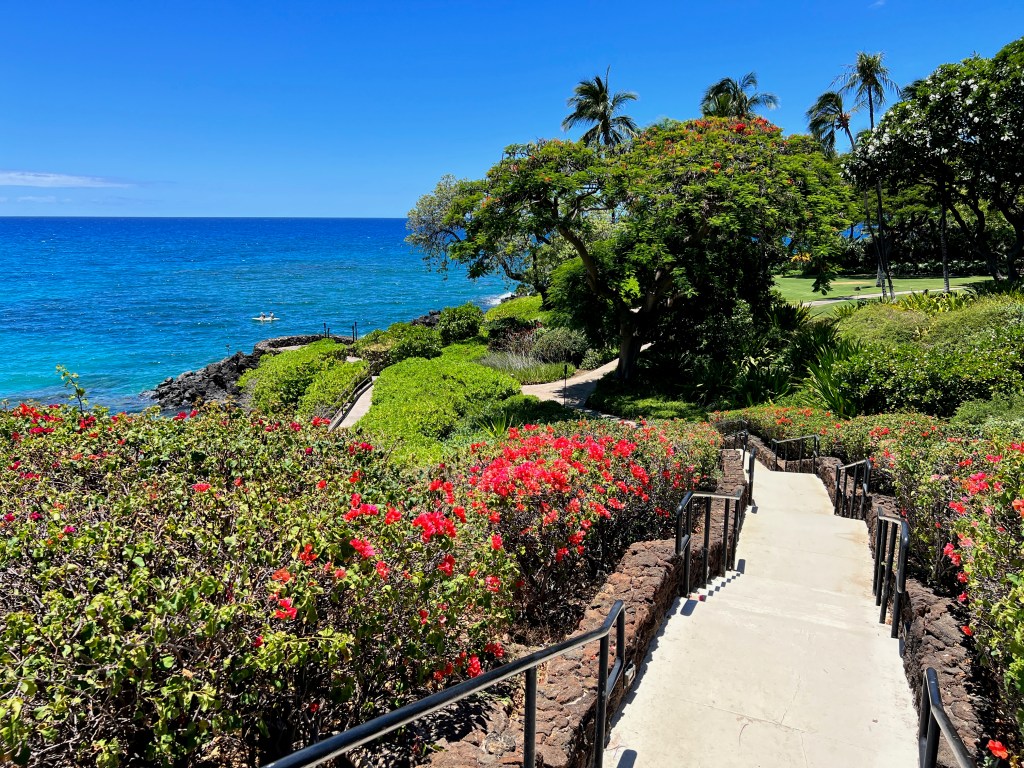
From the Mauna Kea Beach Resort, where it was an exceptionally comfortable 85 degrees fahrenheit (29 degrees Celcius), we set off by Hertz Rental in a Dodge Durango Hemi on the Daniel K Inouye Highway that divides the island of Hawaii in two halves. The skis were bright and sunny. We made good time despite most of the roadway being a two lanes highway.

Climbing the Mauna Kea Mountain:
At the Mauna Kea Access road, we turned off the Daniel K Inouye Highway to start the official mountain climb. The access point highway was already at 2,010 meters (6,594 feet) elevation as we started the ascent. The road was a robust two lane paved twisty highway as we climbed towards the Mauna Kea Observatories.
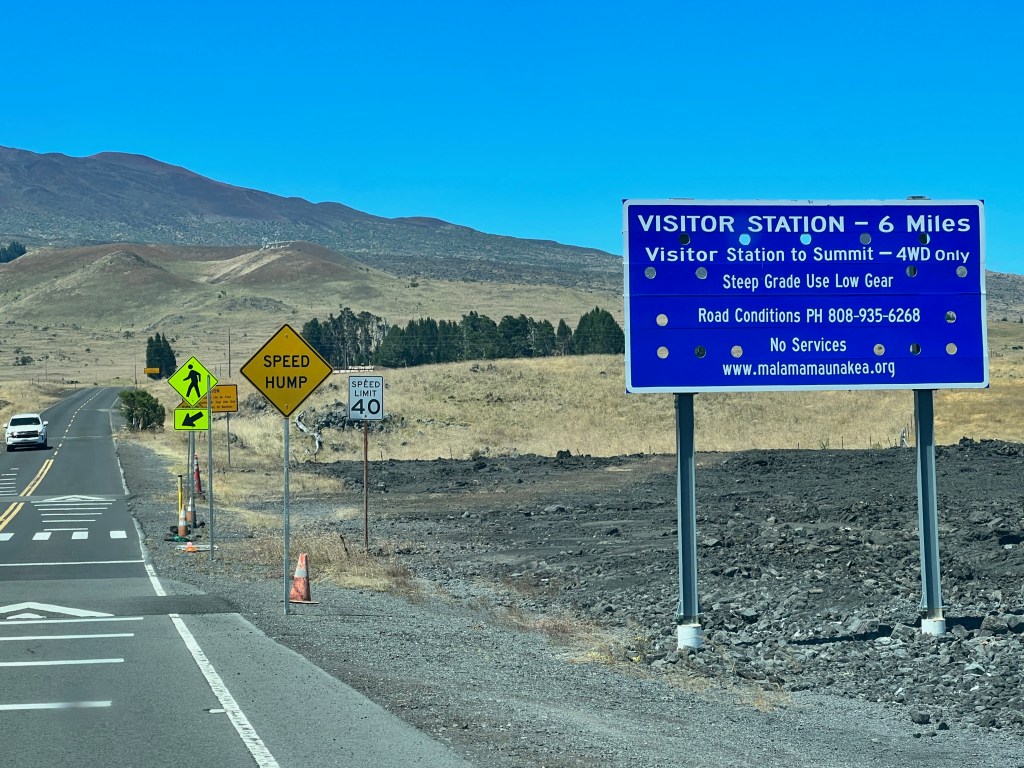
There were substantial sign posts indicating that a 4 Wheel Drive Vehicle was required and that there was the possibility of altitude sickness at higher elevations. Having been physically tested with this throughout many ski holidays through the Summit Range in Colorado, and on holidays to Aspen, Colorado, we didn’t play loose and fast with the recommendations.

Mauna Kea Vistor Station:
The lower paved road started getting twisty in the ascent. We eventually got to the Mauna Kea Visitor Station. It wasn’t possible to miss the visitor station. There were pylons and cones across the roadway directing traffic into the visitor station parking lot.
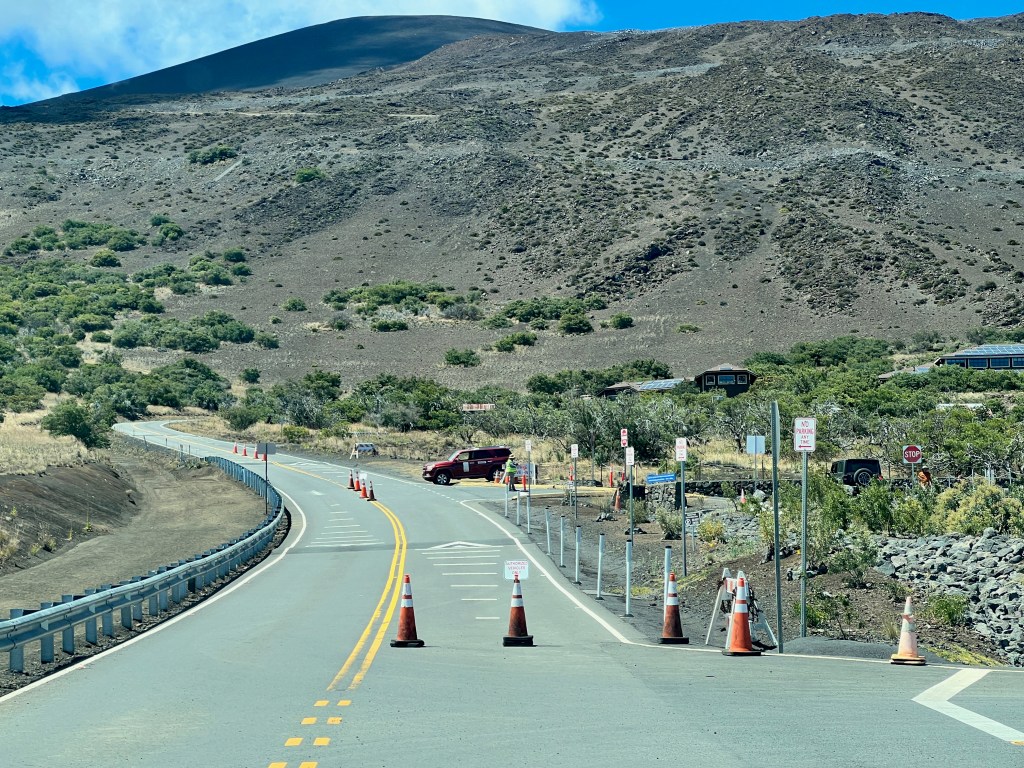
It was pretty busy on arrival at about 2:30 PM in the afternoon. After parking our vehicle in the busy lower lot, we headed up towards the small and functional visitor centre.

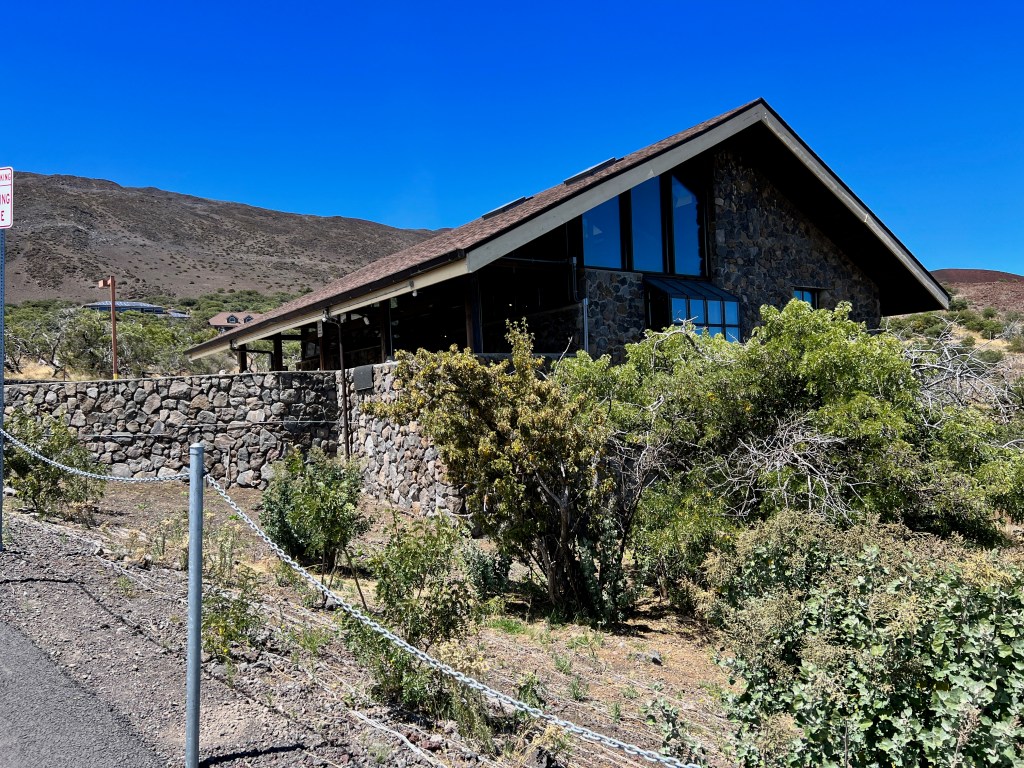
The Mauna Kea Visitor Centre was home to a number of Park Rangers who were able to answer almost any observatory and visit question. We had a mandatory thirty minute rest break at 2,810 meters (9,219 feet) elevation, while our bodies physically adjusted to the change in pressure and oxygen density in the air.
During this self timed period, there were a number of infographic displays that set out all the different observatories and which countries ran them.

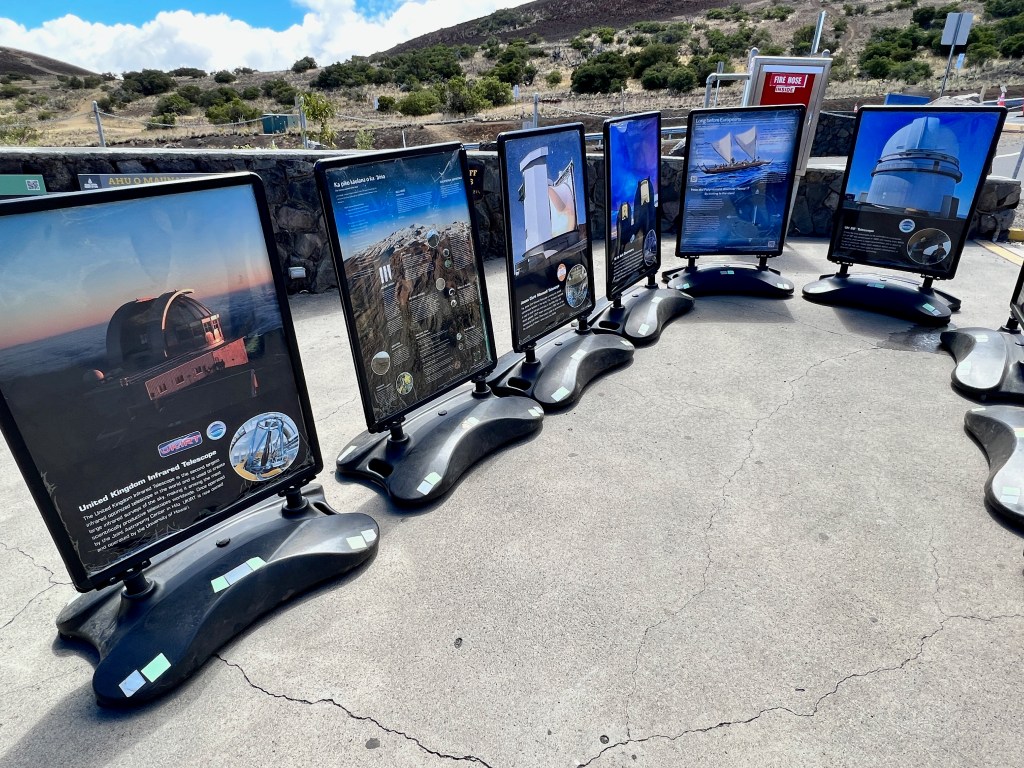
Heading towards the information centre itself, there were a number of dated displays. There were additional hiking information. I was able to pick a few challenge coins designed by Hawaiian students, which made for a neat add on for the local collection back home.

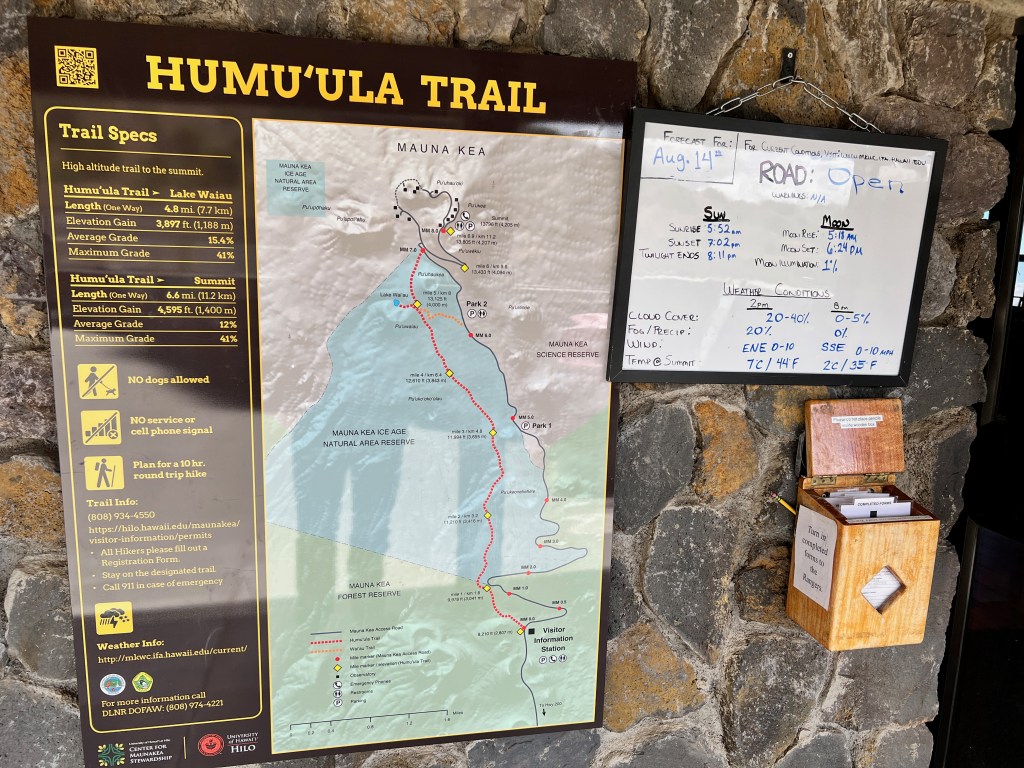
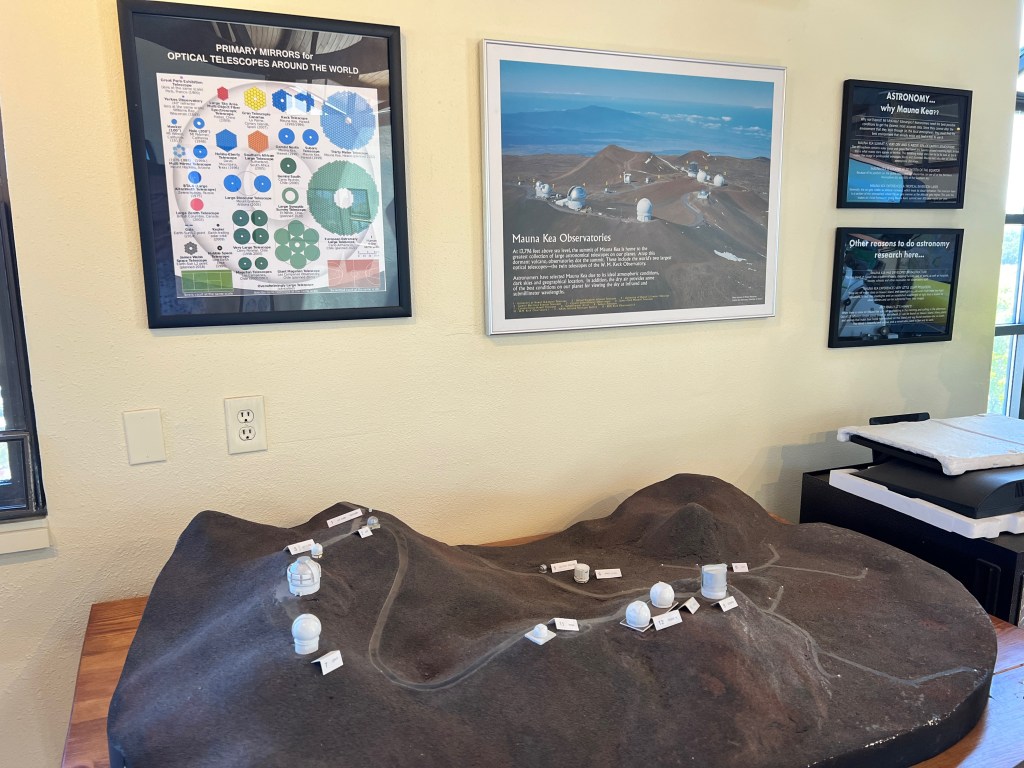
If you happen to be traveling with children under the age of 12, this will be the highest you will be permitted to ascend. Within the area, there appear to be a number of short hiking trails with mountain valley views for those that can’t or won’t make it all the. way to the top.
Travelling Above the Visitor Station:
After our thirty minute break (which actually extended into a forty minute break of our own accord), we packaged ourselves back into the truck and proceeded to the ranger station check point.
Much like the Canada / United States Border Inspection station, we had a three vehicle wait before our turn to chat with the ranger manning the gate on duty.
We were confirmed by the park ranger to be:
- In a Four Wheel Drive vehicle
- That we had no children under 12 travelling with us
- That we had more than half a tank of gas
- That we had spent a minimum of thirty minutes at the visitor centre
- That we did not have any current health conditions or dizziness / nausea
- That we were dressed appropriately for the weather conditions in the apline
Our Dodge Durango was equipped with full time all wheel drive with a push button 4L feature. While I thought there may have been a closer inspection as to the type off our wheel drive, the Park Ranger didn’t seem to concerned about the configuration.
We were given a few driving tips and encouraged to use low gear on the way up and on the way down. We were also told that our brakes had to be below two hundred degrees Fahrenheit before we would be able to leave on the descent, in order to avoid brake failure.
After we successfully passed those checks, we were let through the check point and onwards up towards the Mauna Kea Observatories.
It’s worth mentioning that I saw several families and people in two wheel drive sedans being turned around at the check point. I am guessing that some didn’t do enough research before setting out on their journey.

The paved portion of the roadway came to an end fairly quickly. After that, we found ourselves on some well graded roadway marked with a 25 MPH speed limit.
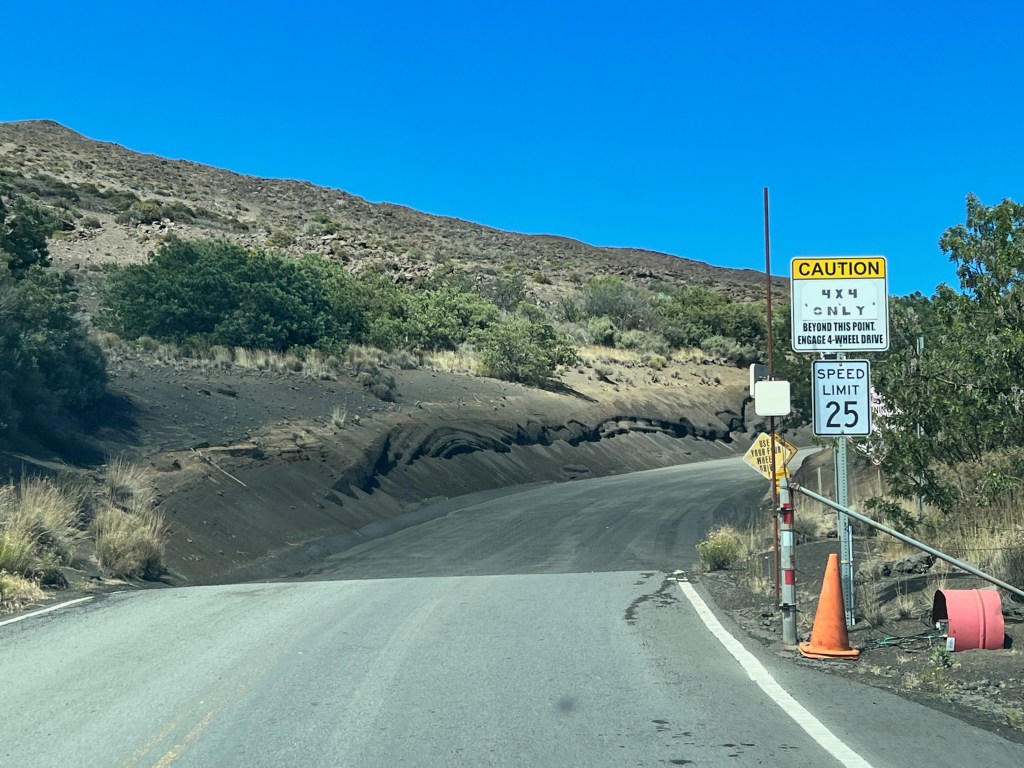
In terms of the ascent, the road quality was in reasonable condition. While I wouldn’t be bringing my own car on such a roadway, the road was manageable for those that have had some experience driving on forest service roads or off road. I ended up driving well below the posted speed limit of 25 MPH, in a low gear on the way up.


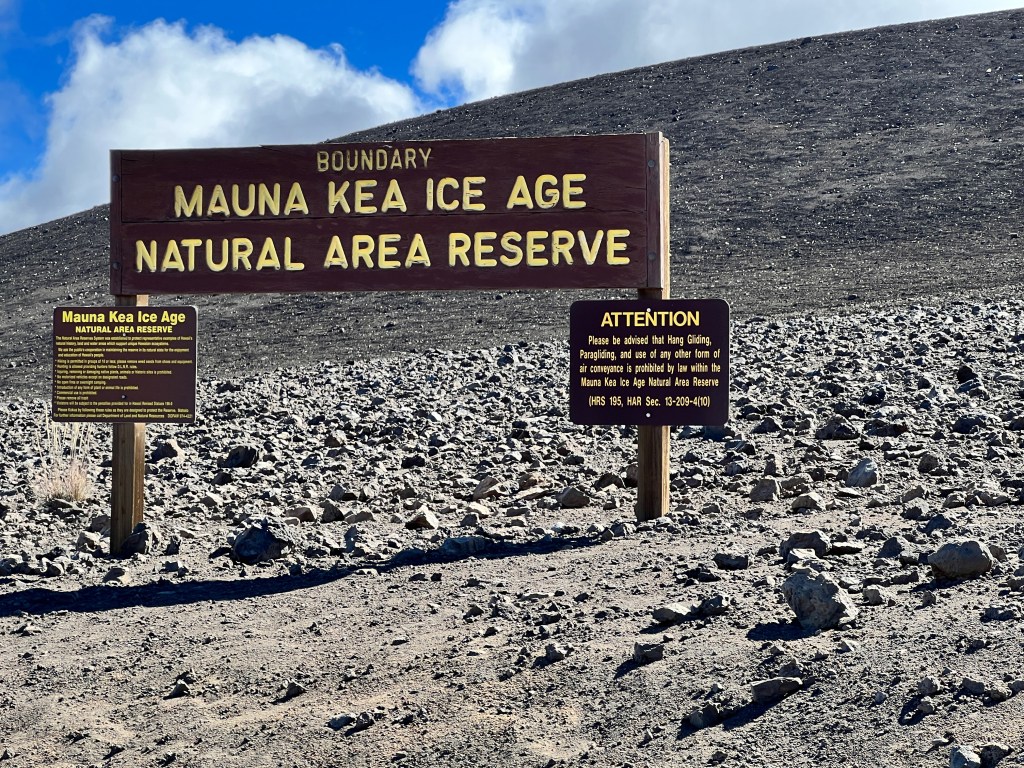
We passed by the Mauna Kea Ice Age natural area reserve, a pretty cool feature of geography when you think that’ it’s been around for much longer than your existence on earth.
Arriving to the Observatories:
Surprisingly, the road near the very top of the observatories became paved once again. As we approached the top of the observatories, we got our first look at these terrific structures.


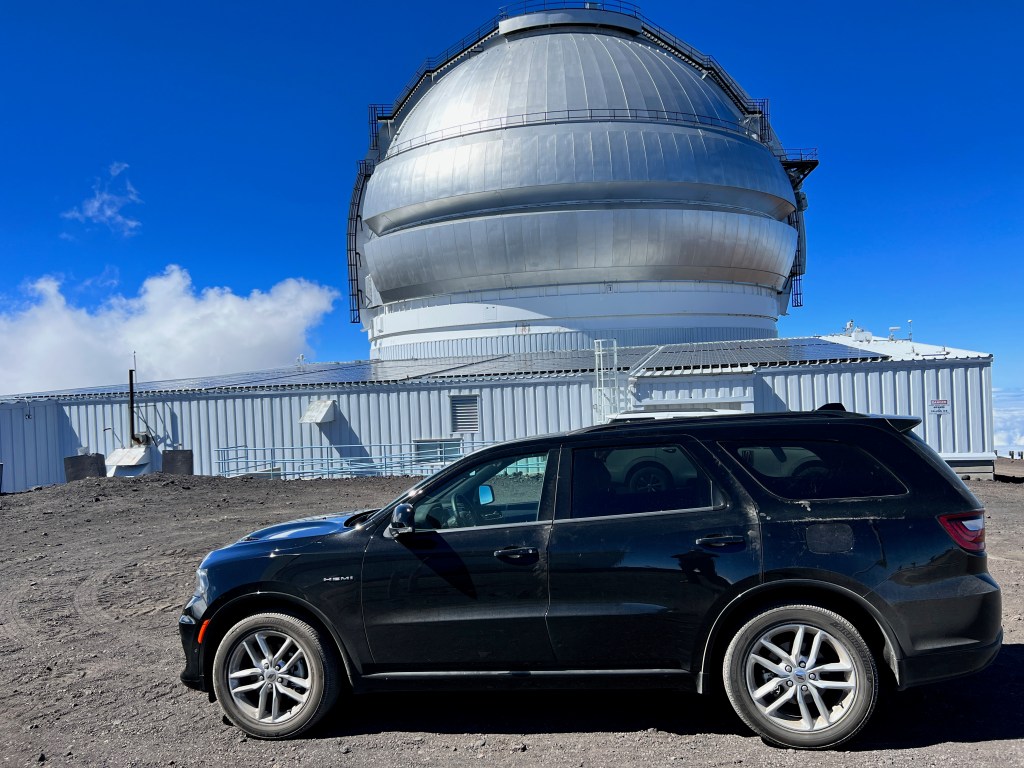
It is pretty neat to get up close to these giant domes, which look like they are right out of an rock music album cover. The fact that these telescopes can reach the farthest ends of space is a neat achievement to see in person.


There was no marked parking at the top and a mostly deserted space. We ended up just parking next to one of these giant telescopes and taking a walk around.
The outdoor temperatures were much cooler than the sea level floor. Dressed in hoodies and long pants, we were in temperatures of about fifty five degrees fahrenheit (12.7 degrees Celcius).
While parked at the Mauna Kea Observatories, my iPhone picked up an elevation reading of 4,220 meters or 13,845 feet elevation. This was higher than anywhere I had physically stood on the globe, and much higher than my visit to Aspen, Colorado, USA; which was around 11,212 feet elevation. We checked ourselves for spins and dizziness, but not running a marathon, we found selves to be pretty good considering the elevation we were standing.
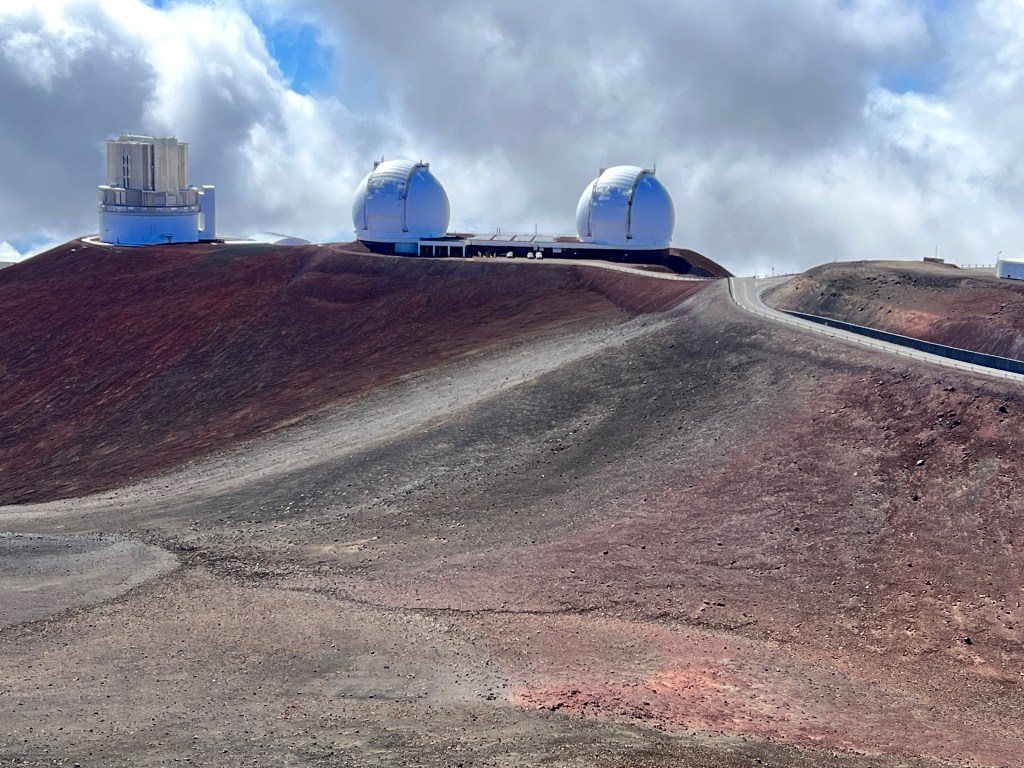
While the odd observatory has a visitor centre reception, we didn’t get into any of the observatories on this visit. Although they were marked as open in our Lonely Planet guidebook, some hastily laser printed paper on the roads announced a closure at 2 PM; well past our 3PM arrival.


With some turbulent weather this afternoon, most of the view towards the seas surrounding the Hawaiian Islands were blocked by large cumulus clouds. We didn’t have any grand top of the world views, although the ridge was pretty scenic as it was.
We didn’t aim to set out on any of the mountain top hiking trails, despite a number of trails running like veins from the top of the Mauna Kea apex.

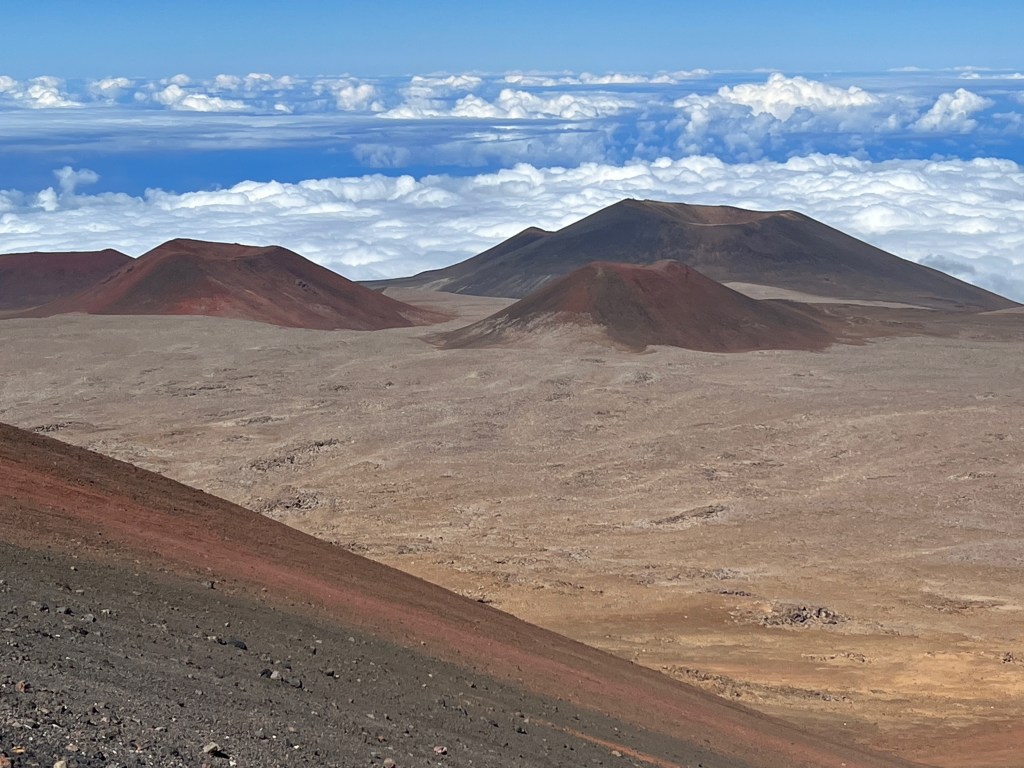
The summit of Mauna Kea and the viewing of the observatories was one of the highlight of our visit to the Big Island.
Descending Mauna Kea Mountain:
Although many visitors stay up for sunset, we ended up descending earlier. The clouds were blocking a large part of our view, and I was also happy to get back to more tropical climates.
The road was more scenic and picturesque on the way down. We were treated to a view of mountains as far as the eye could see, although with an interesting variety of clouds surrounding the feeling of being on top of the world.
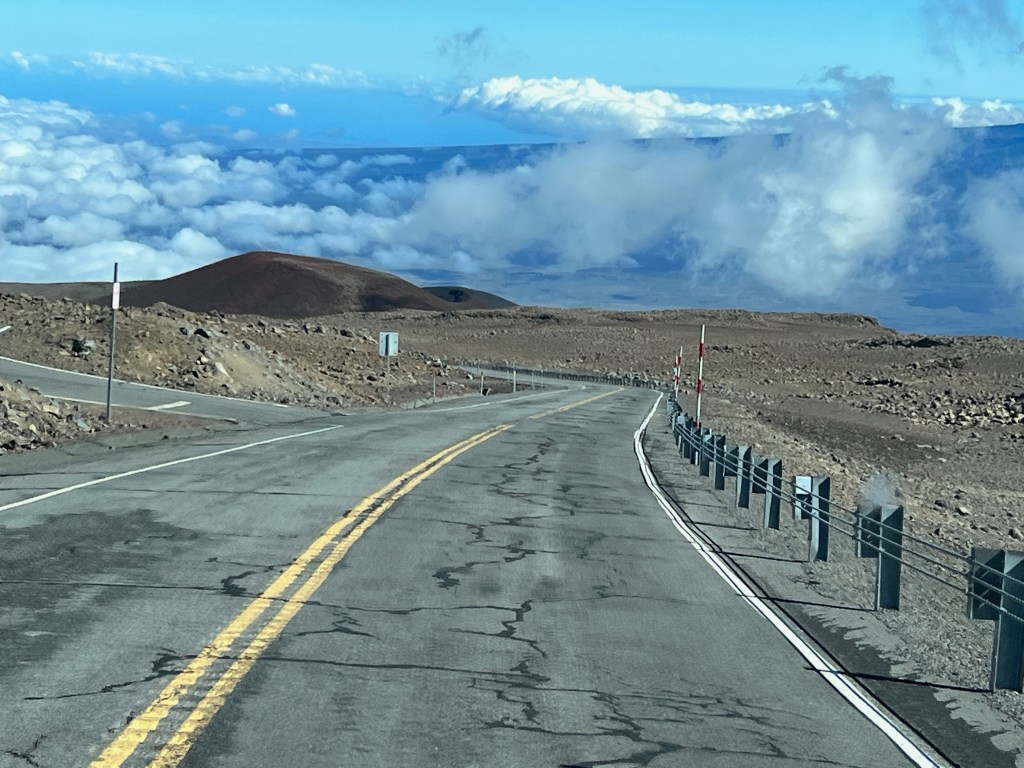

Based on recommendations from the Park Rangers, I used the manual selection on the Dodge Durango to select a low gear going down Mauna Kea and it’s 22% grades. This allowed the engine to complete all the braking, and not the actual brakes themselves. I never had to put the truck in 4L itself. Instead, the engine took all the braking pressure at the expense of fuel economy.
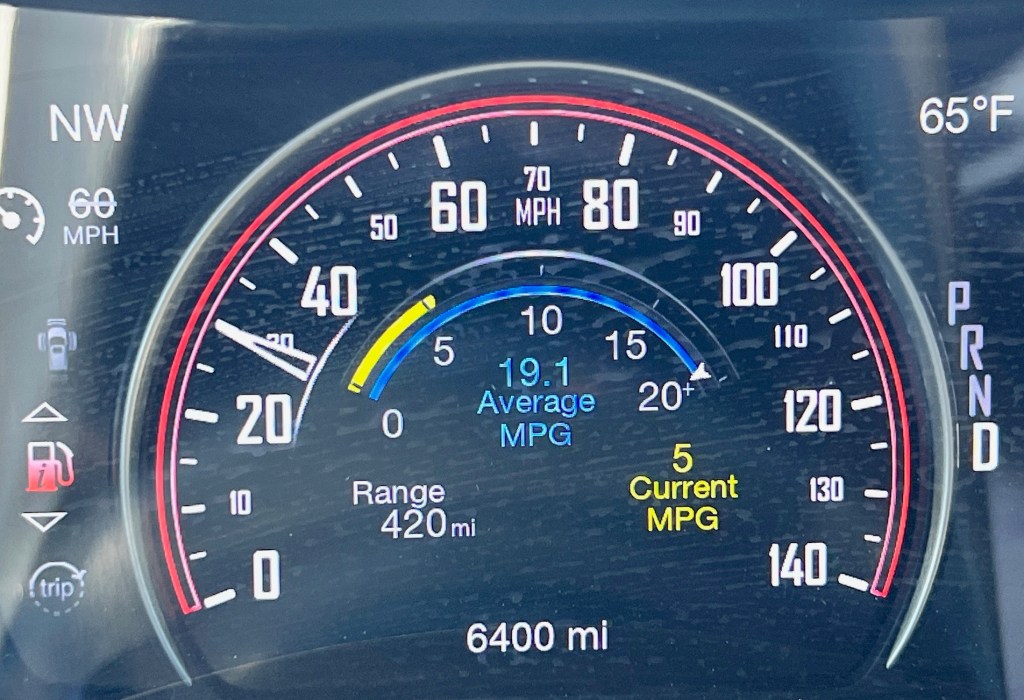
There is nothing like seeing that you’re getting 5 miles per gallon in your fuel economy. I felt a bit bad about it and the environment, but I’m not the type of person to normally drive a HEMI equipped Sport Utility Vehicle anyway.
Visitor Station Exit Checkpoint:
As we descended, we had a mandatory pit stop at the Visitor Centre check point. The Park Ranger actually took our brake temperature using a hand held thermometer. With an announcement of 148 fahrenheit as the reading and a proclamation of “not bad”, we were permitted to continue down, without a further rest stop.
We did get a secondary caution to continue using the engine for braking, as they had seen more accidents on the lower part of the road than the top.
After we got off the Visitor Centre highway, we eventually pit stopped at the trail head for a short driving break. We saw some lava flows that made it to the bottom of the mountain.


We had some great views back up Mauna Kea mountain, with a great sense of accomplishment for the day. We drove back to The Westin Hapuna Beach Resort for the rest of the day.
My Thoughts on Ascending Mauna Kea:
Driving up Mauna Kea Observatories is a popular day trip for any visitor to The Big Island. With a little preparation, the trip can go a lot smoother provided you know what to expect. You’ll need a 4WD vehicle, and you can expect to be turned back at the Ranger Station, if you don’t have one.
We were fortunate to have a lot of available time for this particular journey. Having come prparated for the weather, with a vehicle that was permitted to tackle this terrain, added to the experience.
It’s certainly something that I would aim to revisit if I was ever back on The Big Island.





Recent Comments