 World Traveller 73
My Experience Claiming Compensation for a Delayed Flight with Air Canada


I recently flew a trans continental flight on Air Canada and enjoyed a massive delay in my travels. What was supposed to be seven hour trip with a four and a half hour flight time through the skies, ended up being a twelve hour journey with many mishaps throughout the day. In the end, my travels were delayed about four and half hours. I elected to pursue whether Air Canada would make good on it’s compensation obligations under the Canadian Air Passenger Protection Regulations (APPR) statutory regimes. Read on to see how my experience went.
My Experience Claiming Compensation for a Delayed Flight with Air Canada under Canadian Air Passenger Protection Regulations
On June 1st, I was scheduled to travel on Air Canada AC 114 between Vancouver and Toronto. This was a pretty straight forward work trip on Air Canada’s High Density Boeing 777 aircraft on a weekday Thursday. The flight was scheduled to depart at 12:30 PM, arriving to Toronto at 7:58 PM.
On this day, Air Canada experienced a massive information technology outage, as a result of the airlines decision to upgrade it’s airline communicator system. The airline communication system was described as “one of the systems that we use to communicate with aircraft and monitor operational performance”.
The issue caused 40% of it’s flights (over 500 that day) to be cancelled. The amount of cancellations was so bad, it received national media attention.
Getting back to the day itself, as is the case with many delay experiences, I ended up getting a series of emails from Air Canada with updated flight departure times. I fell into the usual formula of that rolling delay, when a two hour delay was announced, that later became into a four hour delay.


My 12:30 PM flight would ultimately end up leaving at 4:15 PM; more than 4 hours and half hours late. The end result was that the flight would end up arriving in Toronto Pearson International Airport at 12:31 AM; more than 4 hours and 33 minutes late from our scheduled arrival time of 7:58 PM.

Given that information (and evidence) is often your best friend in this circumstances, I made the efforts to capture all sources of the delay through Flight Aware, Twitter, and even within the Air Canada app.
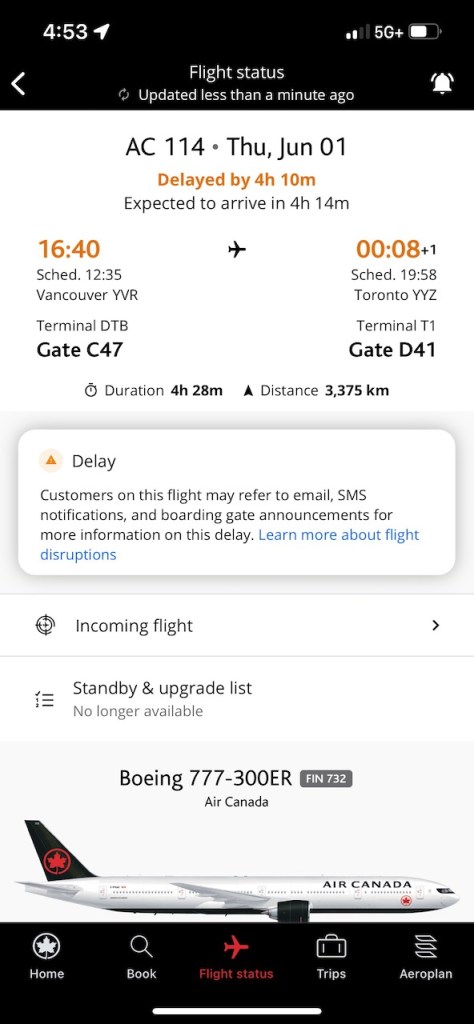

This length of delay beyond three hours made me eligible for compensation under the Canadian Air Passenger Protection Regulations.
The Canadian Air Passenger Protection Regulations:
Canada has recently introduced Canadian Air Passenger Protection Regulations (APPR). It is also worth mentioning that there may be other statutory regulations that apply to your journey; such as the European Union Air Passenger Rights regulations which is typically more generous than the Canadian regime.
There has been some controversy on the application of the Canadian Air Passenger Protection Regulations, as they have been seen to be very biased in favor of the airlines, instead of the travelling public.
The regulations have the force of law. This means that any oversight of this would occur within the civil disputes jurisdiction within your province or territory. In British Columbia, this means that it would fall into the Civil Disputes Resolution Tribunal for all claims under $5,000 Canadian Dollars.
I’m not a lawyer and I don’t play one on television, but the guidelines seem fairly clear.
The Canadian Air Passenger Protection Regulations require several essential elements that include:
- Information (communication)
- Re-Booking (option to rebook on alternative flights after three hours of delay)
- Refund (option to refund after three hours of delay)
- Standards of Treatment (numerous conditions apply)
- Compensation (numerous conditions apply)
- Recourse
Specific to my flight, as a result of the four and a half hour delay, I would have standing to pursue a claim under the Standards of Treatment and Compensation provisions of the statute. Let’s look at each of those in turn.
Canada Air Passenger Protection Regulations – Standards of Treatment:
The Canadian Air Passenger Protection Regulations outlines several standards of treatment.
If, due to a situation within Air Canada’s control or required for safety purposes, (i) you have been informed of the delay or cancellation less than 12 hours before the departure time indicated on your ticket, and (ii) you have waited two hours after the departure time indicated on your ticket, we’ll provide you with the following:
- Food and drink in reasonable quantities, considering the length of the wait, the time of day and location;
- Access to a means of communication; and
- Hotel or comparable accommodations within reasonable distance from the airport for overnight delays for out-of-town passengers, subject to availability.
I ended up killing off this delay at the Plaza Premium Lounge Vancouver Domestic. It happened to be where I was as the delay emails came in. Perhaps not surprisingly, there was no mention in the emails to see a gate agent for food and voucher compensation. As I had food available within the lounge, I didn’t bother to pursue any food of beverage vouchers. I also happened to be on a per diem allowance by my employer, so I didn’t have any immediate concerns there.
While I wasn’t at the gate, I haven’t typically found Air Canada to be all to generous with respect to handling passengers when it comes to delays. This is in contrast to Alaska Airlines that tends to bend over backwards for it’s delayed passengers. Alaska Airlines typically provides food and beverage vouchers in addition to pro-actively offering several thousand Alaska Airlines Mileage Plan Miles, in my past experience.
Canada Air Passenger Protection Regulations – Compensation:
The Canadian Air Passenger Protection Regulations outlines several standards of compensation. This is where it gets a little more complicated in terms of terms and conditions:
If, due to a situation within Air Canada’s control, your flight was delayed three hours or more, or cancelled, you’ll be entitled to receive compensation, unless:
a) You do not have a confirmed reservation or are travelling on a fare that isn’t available, directly or indirectly, to the public;
b) You are informed of the delay or cancellation at least 15 days before the scheduled time of departure;
c) Your flight was delayed or cancelled due to situation outside of our control or required for safety purposes;
d) You have already been paid denied boarding compensation;
e) You have already been paid under another passenger rights regime for the same event;
f) You failed to submit your claim within one year of the flight delay or cancellation.
Compensation for delays and cancellations is calculated, based on your arrival time at final destination and is:
– 400 CAD for delays at arrival between 3 and 6 hours;
– 700 CAD for delays at arrival between 6 and 9 hours; and
– 1,000 CAD for delays at arrival of 9 hours and more.
Under my circumstances, with a four and half hour delay, I appeared to fall within the $400 CAD category and appeared to have the statutory ability to claim $400 Canadian Dollars.
Starting the Claims Process:
Given the length of the flight delay, I thought that I would make an attempt at making a claim under the Canadian Air Passenger Protection Regulations. I wasn’t being compensated for my time through my employer, and going to sleep at 3 AM as a result of the delay, caused some travel disruption in my days off and into the weekend.
Air Canada didn’t provide communication on how to apply for compensation, and I had to do a little research one line on their website on how to make an application.
I eventually located a flight compensation link from within the customer support section of the Air Canada website.

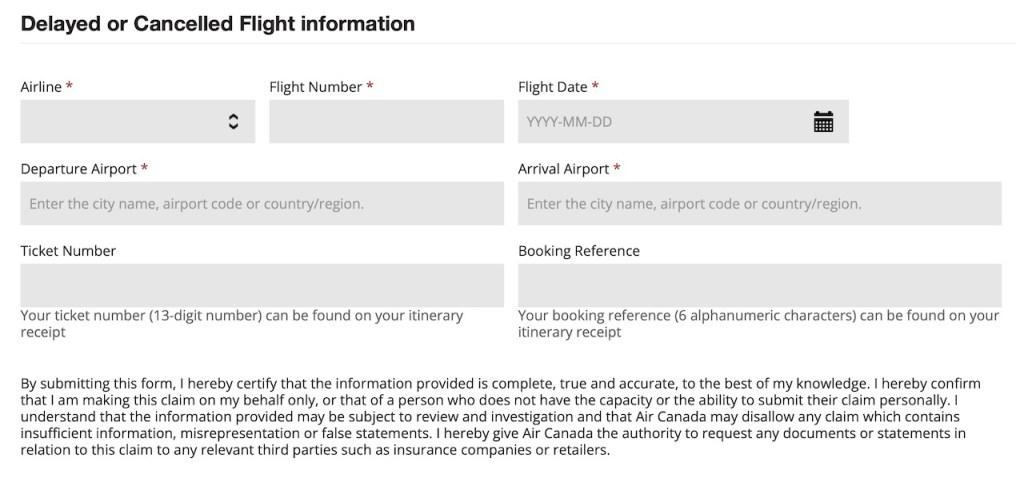
The website offered a look up feature to determine if you were eligible. for compensation. This involved entering your flight number, flight date and ticket information.
Perhaps not surprisingly, given Air Canada’s lack of a strong reputation in adhering to the Canadian Air Passenger Protection Regulations, when I looked up my flight the day after arrival, initially it stated that it didn’t have a decision.

Secondly, when I looked up the flight around five days after the flight, it in it indicated I was not eligible for compensation.

Given the national media attention on this date, I figure that I’d give it a few days before submitting a claim. As a result of so many travellers being delayed, I figured eventually there would be a management decision on how to treat all travellers impacted by the delays on this date.
Submitting a Claim:
About ten days after my travels, I submitted a APPR claim through the Air Canada portal. This required filling out a small amount of information.
The hardest part was actually locating my ticket number, since by reference booking code had already expired, and was not searchable anymore.
I also submitted a claim on behalf of MrsWT73, who was travelling with me on the same flight- although on a completely separate ticket and reference number.
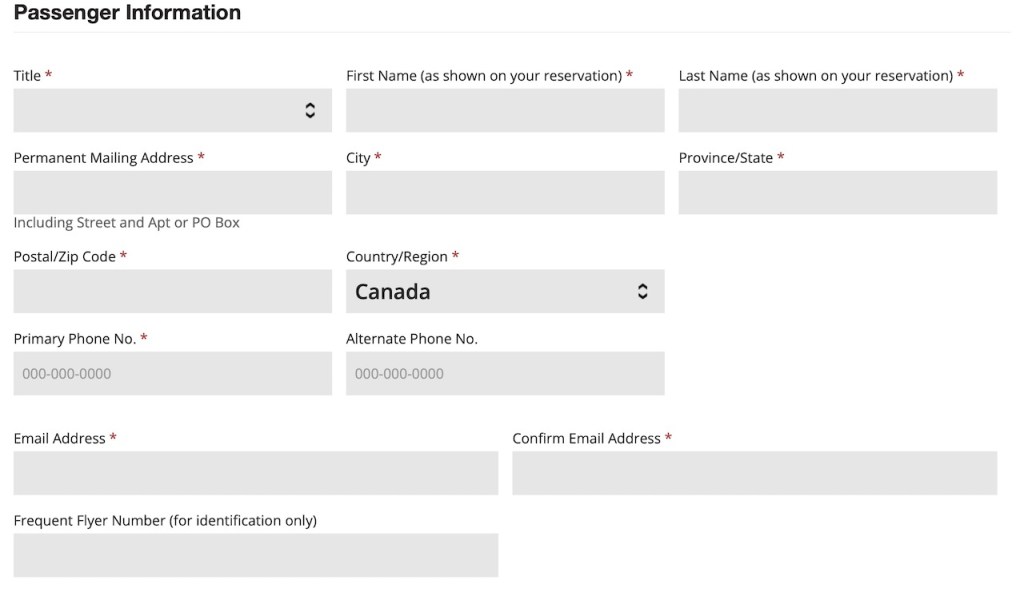
It’s worth mentioning that at the time of application, that my status under the eligibility status didn’t change, and was still showing as “Not Eligible” for compensation.

After submitting a claim, I received an automated message on the Air Canada website indicating that my claim had been received.
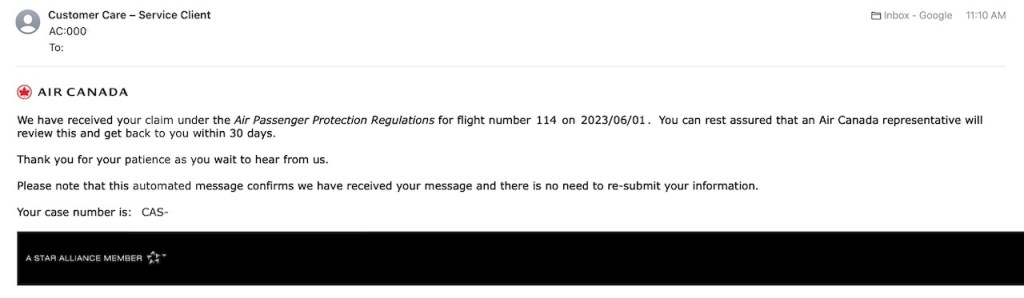
I also received an email to my email account, that indicated I would expect a response within thirty days.
The Result:
About three days after the flight, I received an email with great news.
My claim was successfully awarded. I was being given the $400 as required under the statutory provisions of the Air Passenger Protection Regulations.
The email contained a password to accept the Interac E-Transfer, with payment promised within two to four business days.

As promised, three days later, an email arrived in my account with a link to Interac e-transfer my funds. Following the link through, it took me to my financial institution and prompted entering of the password.

I entered the password. Instantly, $400 was instantly deposited into my preferred bank account.
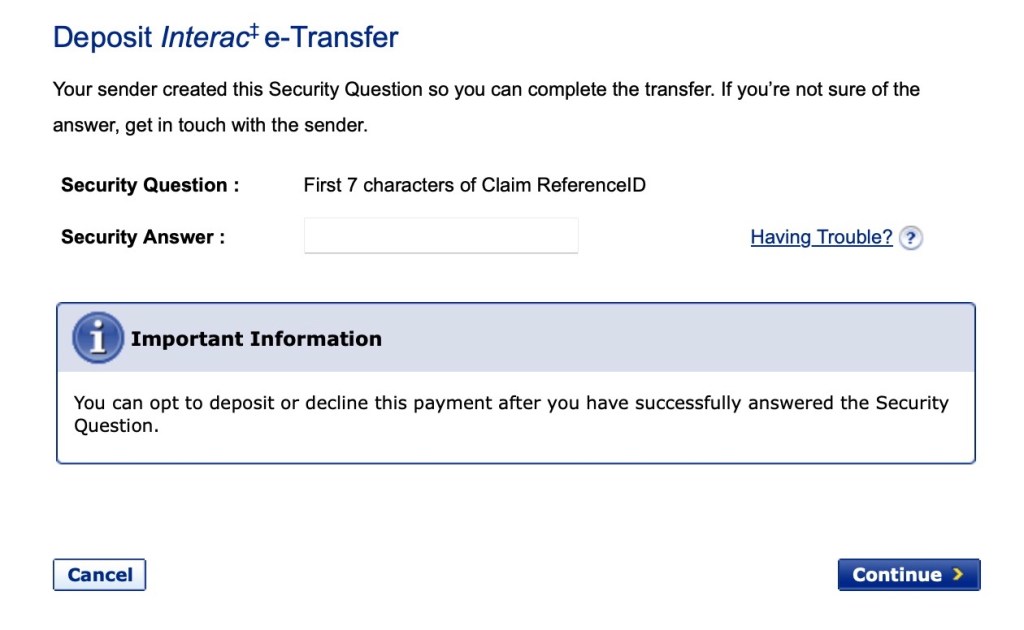
The whole process took exactly seven calendar days from the time that I submitted the claim, to receiving funds in the back account. Overall, it was pretty timely considering some of the horror stories we’ve heard about passengers trying to get refunds, as a result of pandemic related cancellations and delays.
Lastly, it’s worth mentioning that my claim and MrsWT73’s claim was processed at different times. Despite submitting her claim after mine, her file seemed to be processed quicker. She ended up with her money a little bit earlier, at the 6 day mark.
What Other Options I May Have Had to Pursue:
If Air Canada decided to deny this claim, it would have been up to me to pursue this through the provincial disputes resolution process located in the province of territory that I resided in. This would have have involved “going to court” in order to file a claim against the air carrier.
This would have meant researching my circumstances, preparing and presenting legal arguments and taking time off of work in order to pursue the matter.
I would have had to establish that my circumstances were within the 5 elements required under the Air Passenger Regulations Act
a) You do not have a confirmed reservation or are travelling on a fare that isn’t available, directly or indirectly, to the public;
b) You are informed of the delay or cancellation at least 15 days before the scheduled time of departure;
c) Your flight was delayed or cancelled due to situation outside of our control or required for safety purposes;
d) You have already been paid denied boarding compensation;
e) You have already been paid under another passenger rights regime for the same event;
f) You failed to submit your claim within one year of the flight delay or cancellation.
Most noteworthy is the ability to challenge point “C”; that the matter was a circumstance outside of Air Canada’s control or required for safety purposes.
This would have resulted in attempting to argue that information technology upgrades are within the control of the airline’s purview of when they schedule or elect to perform such upgrades when planes are operational as opposed to when planes are parked on the ground.
Fortunately, the event caused wide scale national media attention and the reasons for the delay were well published. This many not have been the case for more minor delays where the delay reasons are usually much more opaque.
My Thoughts Air Canada’s Response to Claims under Air Passenger Protection Regulations:
My efforts at claiming compensation under Canada’s statutory program for a delay on Air Canada was pretty straightforward.
My claim was processed and adjudicated within 7 days; and was likely helped as likely assisted by national media attention as a result of the amount of cancellations that occurred.
Obviously, this was a case where everything worked out really quickly, but that’s not always the circumstances when dealing with flight delays. The lesson learned out of this incident, is always to make an application under the statutory regime applicable to you; and to research whether there are any better statutory regimes (such as the European Union’s regime) that might put you in a more favourable circumstance.





 World Traveller 73
I had a flight YYZ-YUL-CDG on June 1st. They have only given me a evoucher for the YYZ-YUL flight of $300. They do not refer to the YUL-CDG flight for which I submitted a claim as well. I re-submitted the claim for the YUL to CDG segment. All of this is on one ticket.
LikeLike
It will be interesting to see what you end up with. My interpretation is that, unless you’re on two tickets (and two separate qualifying delays), it’s typically covered under one claim. You may have different luck.
Report back if you’re successful!
LikeLike